GateWay Community College complements its renovation with a state-of-the-art AV system

“This classroom design with the VP-729 scaler/switcher as the backbone enables us to display any analog or digital AV device on the screens with easy interface control.”
Senadz Lubovac | Coordinator of Audiovisual, IT, GateWay Community College

Background

GateWay Community College (GCC), in Phoenix, Arizona – with approximately 13,000 students – is part of the largest community college district in the United States.

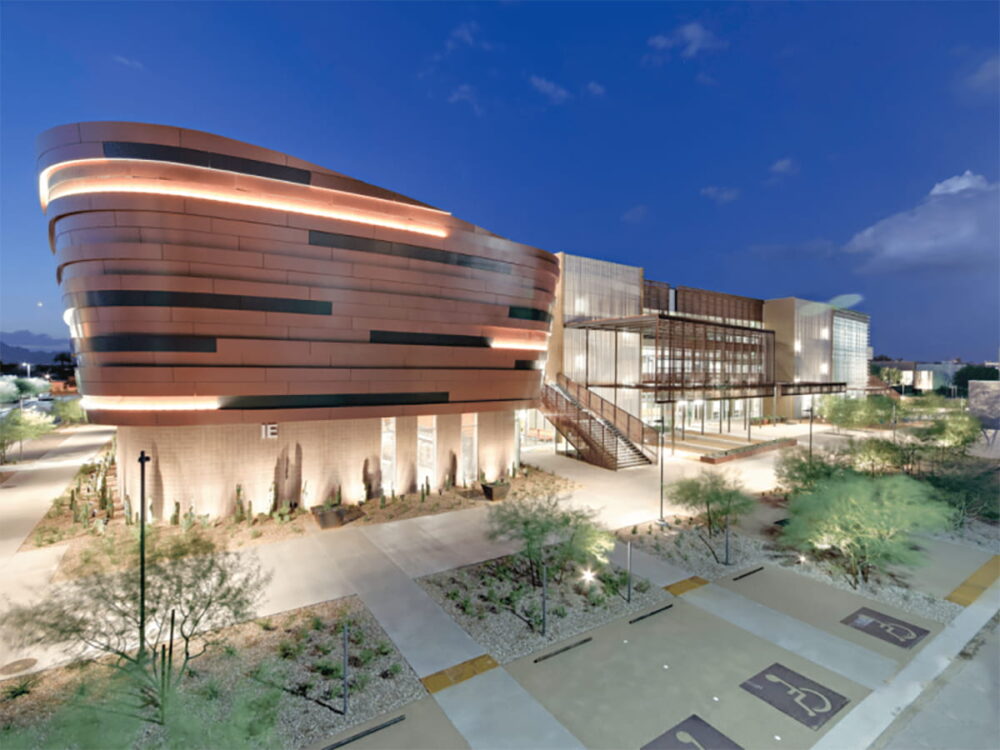
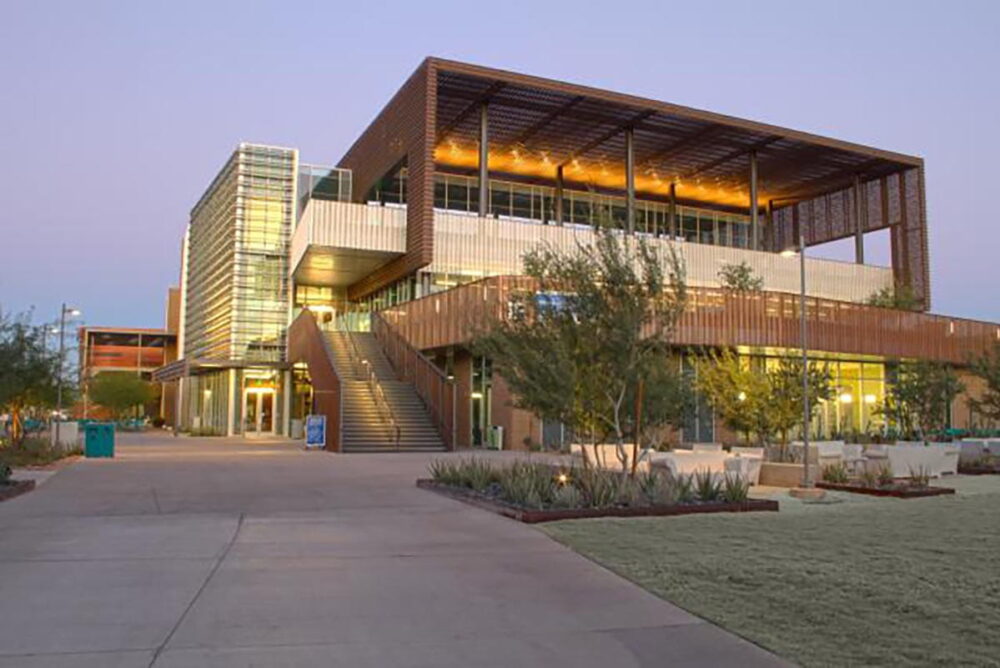
During a recent renovation, the college added 23 new classrooms, a PC networking lab, a vocational skills lab, two conference rooms, and a tri-divisible multi-purpose room. This new 125,000-square-foot Integrated Education Building also has 15 dual-screen classrooms, a single-screen art studio, and a three-screen multi-purpose room with over 200 seats. Around the same time, the college also remodelled the Maricopa Skill Center, a vocational school and division of Gateway Community College.

Goals

GateWay Community College wanted a state-of-the-art AV system and IT classrooms to complement its new Integrated Education Building and remodelled Maricopa Skill Center. The system needed to allow students and faculty access to digital AV and HDCP content in a simple-to-use configuration. 

An intuitive model that would be identical in all rooms was required, to reduce the need for troubleshooting by technical support staff. The college also needed to integrate digital and analog devices in the classrooms and reduce the size and cost of lectern-to-projector cabling.

Solution

For the classroom systems, the GateWay AV team selected the Kramer VP-729 ProScale® digital scaler/switcher and Kramer TP-573, and TP-574 DGKat™ twisted pair transmitters/receivers for HDMI, bidirectional RS-232, and IR signals – all of which are housed in a slim lectern in each room.

The VP-729 sits at the heart of the conference rooms. Videoconferencing equipment and a 60- or 70-inch display were also added. All multi-purpose rooms follow the same configuration and include a Kramer VS-66HDCPxl 6×6 DVI Matrix switcher, TP-581T/582R HDBaseT twisted pair transmitters/receivers, and FC-46xl audio de-embedders.

“After comparing the features, complexity, and pricing of a variety of products, we decided to use Kramer as a core infrastructure in designing our standardized classroom because it met our needs to handle both HDMI and HDCP,” says Senadz Lubovac, Coordinator of Audiovisual Information Technology at GateWay Community College.

Value

The relevant rooms in the Integrated Education Building and remodelled Maricopa Skill Center are now equipped with a state-of-the-art AV system. Intuitive to operate, the new technology gives students and faculty easy access to digital AV and HDCP content. And there’s little need for help calls to the college’s technical support team.

“This design with the VP-729 scaler/switcher as the backbone enables us to display any analog or digital AV device on the screens with easy interface control,” says Lubovac.

With the budget, a major success factor for GCC, “Kramer’s pricing made a real difference.”

Tags:

Education

Collaboration Applications

Signal Management

Americas

United States

Got a question for one of our AV experts? Contact us here, and we’ll connect you.

Illinois State University classrooms go digital with a seamless user-interface from Kramer

Quote Icon
“We put in a standard user interface and they know that if they press ‘computer’, the magic happens and the computer shows up on their projector, and they don’t have to think about it.”
Doug Smith | Director, Illinois State University

Background

Illinois State University, located in Bloomington-Normal, Illinois, was the state’s first public university.  Founded in 1857, the school has approximately 18,000 undergraduate students, 2,300 graduate students and 3,560 employees, including 1,224 departmental faculty. Illinois State University has received numerous awards.

For 2017, U.S News & World Report ranked the school 78th among America’s best public universities for academic quality and excellence. Illinois State received a rank of 22nd from College Factual among the best colleges for the money out of 1,200 schools and was included among the country’s best universities for veterans. Illinois State is also listed among the best schools for military and veteran education by Military Advanced Education & Transition and was named a “Gold Medal-level Military Friendly School” by Victory Media. 

Goals

Illinois University wanted to find a digital audio-video solution for its classrooms that would allow faculty to easily switch between different video sources in 320 classrooms. In 2009, the university began to add more AV technology in its classrooms, but incident rates reflected the fact that faculty members had trouble using it. To reduce the number of incidents and service calls, the customer wanted to switch all classrooms to digital while ensuring ease of use.

Kramer was tasked to convert all 320 classrooms with the appropriate scaler/switcher to make sure the faculty’s user experience was seamless no matter where a class was being held.

Solution

The Kramer custom integrator recommended the VP-728* and VP-730* and a 9-input ProScale™ presentation scaler/switchers for analog and digital video with picture-in-picture, picture-and-picture, and split-screen capability. In addition, the VP-773A, an 8-input HDMI & HDBaseT ProScale™ presentation switcher/scaler with 2K support and an audio power amplifier was installed in each of the classrooms. In so doing, Illinois State was able to convert all 320 classrooms to digital capabilities with easy-to-use interfaces.

Value

Kramer presentation switchers have allowed Illinois State AV specialists to provide faculty with a standard setup for each classroom. “They can go from room to room and know what’s going to be there such as a computer, document camera, and the likes; and Kramer has the switching core. We put in a standard user interface and they know that if they press ‘computer’, the magic happens and the computer shows up on their projector, and they don’t have to think about it,” says Doug Smith, Director, Learning Spaces and Audio-Visual Technologies at Illinois State University.

Doug further explains that despite there being more technology now, the incident rate has plummeted. “As we ramped up our responsibilities, the number of times we had to go in and revisit rooms just kept dropping. The impact has been staggering.”

In addition, through reduced service calls and incidents, among other things, Doug adds that the Kramer solution has saved the university money. “The product is rock-solid, Kramer support is rock-solid and the solution saves me money every time I turn around”.

* The VP-732 is Kramer’s most current product for this specific use (recommended).

Tags:

Education

Collaboration Applications

Signal Management

Americas

United States

Got a question for one of our AV experts? Contact us here, and we’ll connect you.
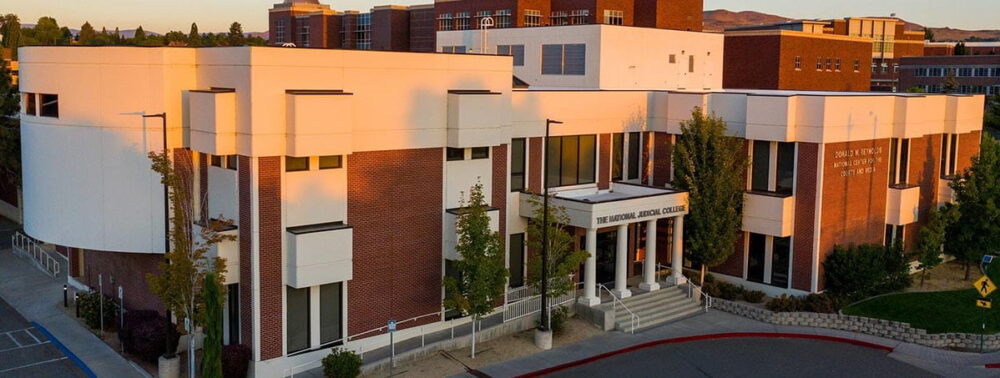
The National Judicial College does justice to courtroom communications with its updated AV system

Quote Icon
“We designed the system using Kramer equipment because we know Kramer’s track record for reliability and ease-of-use.”
Kevin Sandler | CEO and Founder of ExhibitOne

Background

Founded in 1963, The National Judicial College (NJC) is a leading provider of judicial education in the US. The first to offer programs to judges nationwide, the NJC continues to work with the judiciary to improve productivity, challenge current perceptions of justice, and inspire judges to achieve judicial excellence. The college offers an average of 90 courses and programs annually with more than 4,000 judges attending from all 50 states, US territories, and more than 150 countries.

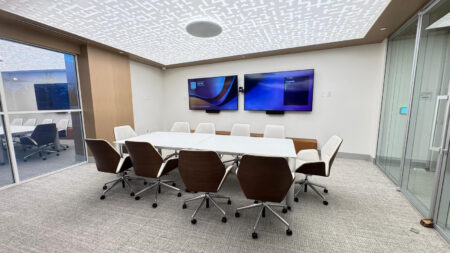
The NJC’s 50th  anniversary in 2013 culminated in the opening of its 90,000-square-foot facility that houses five state-of-the-art classrooms, a 150-seat auditorium, a multimedia room, and an updated model courtroom. 

Goals

The challenge was to manage and control a seamlessly integrated, easy-to-use audio/video system that would facilitate communication throughout several rooms and consistently reproduce an outstanding signal.

Quote Icon
“This system is a showcase for judges throughout the country, so the technology had to be stellar and reliable, as well as user-friendly”
Kevin Sandler | CEO and Founder of ExhibitOne. 

Solution

The audio-video technology in the courtroom is anchored by Kramer products.

The model courtroom system includes a VS-162V 16×16 composite video matrix switcher and a VS-3232DN modular multi-format digital matrix switcher for signal management. Each attorney table has a SID-X1 multi-format video over a twisted pair transmitter and Step-in Module that allows the input of up to four sources (HDMI, DVI, VGA, and DISP Port), plus audio. 

The signal, which is routed through the switchers and the PT-572+ twisted pair receivers, can be switched to the main courtroom displays as well as individual displays at the jury box, attorney rooms, and media room using an intuitive touchscreen panel. Signals are routed through the twisted pair transmitters and receivers and distributed as necessary by a VM-1H4C twisted pair distribution amplifier or VM-8H HDMI distribution amplifier. An FC-46xl audio de-embedder reproduces clear HDMI audio signals for the courtroom. 

Value

“We designed the system using Kramer equipment because we know Kramer’s track record for reliability and ease-of-use, and the Kramer technology consistently reproduces an outstanding signal every time,” said Kevin. 

The system now allows communication throughout the mock courtroom with individual video screens and big screen displays as well as video to the jury room, media room, judge’s chambers, and attorney rooms.

Tags:

Education

Control

Americas

United States

Got a question for one of our AV experts? Contact us here, and we’ll connect you.
Sheldon College fortifies its BYOD learning environment with Kramer VIA Collage

Quote Icon
“We tested and evaluated a number of the leading brands of wireless collaboration systems, and VIA Collage was chosen as the best of its kind.”
Julian Stirling | Design Manager, Integration Partners Australia

Background

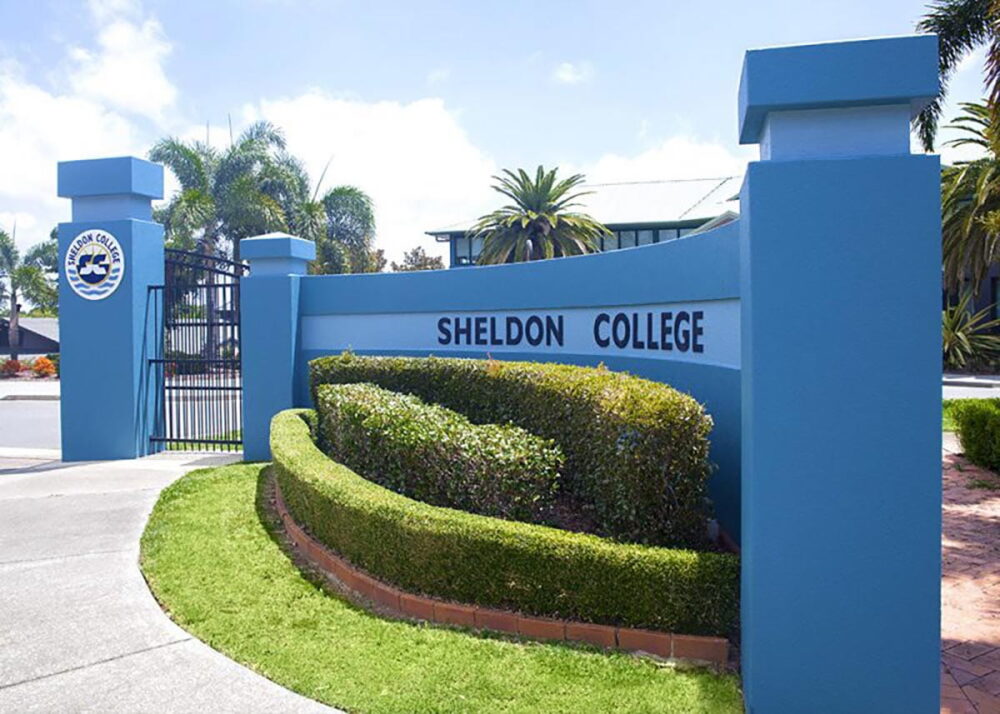
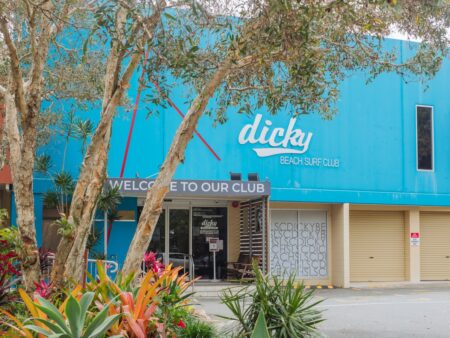
Sheldon College is a private school located in the beautiful Brisbane Bayside area in Queensland, Australia. It caters to a wide-ranging student body starting from 15-month-olds up to grade 12. A state-of-the-art school, it boasts the latest technology infrastructure, business entrepreneurial suites, a modern library, resource centers, and more.

Over the years, Sheldon College has integrated industry facilities and training opportunities across the campus as part of its strategic vision and curricular priorities. One major curriculum-building project has been the construction of a truly collaborative learning precinct. Known as The Learning and Innovation for a New Queensland (LINQ) Precinct, it is designed to provide opportunities for collaboration across the curricular areas of Business and Enterprise, Computer Aided Design (3D Printing, Robotics, and Engineering), Film & Television, and Online Media Production.

Goals

Sheldon College was looking for a way to encourage collaborative thinking and enhance its students’ learning experiences in the new LINQ interdisciplinary facility. The goal was to make presenting and sharing content in the classroom easier and more efficient.

One of the principal challenges was compatibility with the school’s Bring Your Own Device (BYOD) policy for students, which has replaced traditional pen and paper. This means ideas are hashed out and classwork is now completed with multimedia.

“We needed a solution for the wireless connectivity of the students’ portable media devices,” says Julian Stirling, Design Manager for Integration Partners Australia, the Brisbane-based pro AV integrator that handled the project. The students’ devices include iOS and Android tablets, Windows and Mac notebooks, and laptops. With a variety of operating platforms and release versions, the system designers had a complex hurdle to overcome — until VIA Collage entered the picture.

With a variety of operating platforms and release versions, the system designers had a complex hurdle to overcome – until VIA Collage entered the picture.

Solution

To help further collaborative classroom experiences in a BYOD environment, VIA Collage was installed in the LINQ facility.

VIA Collage was chosen as the solution by the integrator after comparing multiple products on the market. “We tested and evaluated a number of the leading brands of wireless collaboration systems, and VIA Collage was chosen as the best of its kind currently on offer,” Julian adds.

Integration Partners Australia and Sheldon College worked together to install the AV system for the new building. The building includes ten collaborative classrooms, a fully equipped TV production studio with satellite editing suites and a lecture theater that doubles as a digital 7.1 cinema and performing arts space. Outside the building is a huge video wall that showcases the learning activities happening inside. Several centralized Kramer VIA Collage units are integrated into the design and are available to all students as a shared resource.

Value

Since installation, VIA Collage has become an integral element of the LINQ facility.

This installation marked a shift from the traditional approach of the teacher’s PC projected in the classroom, to a more immersive collaborative environment. Students can now participate more interactively, sharing ideas and information with the class straight from their own devices, regardless of the brand or operating system.

This in turn is transforming how students learn and prepare for 21st-century work environments.

In addition to enhancing the learning experience, the new AV system has also proven reliable, easy to use, and cost-effective. As Julian summarizes, “We particularly liked the quality and responsiveness of the live video scaling, the ease of set-up, and use across all device platforms, the high build quality, and general affordability.”

Tags:

Education

Collaboration Applications

APAC

Australia

Got a question for one of our AV experts? Contact us here, and we’ll connect you.

Educational Testing Services (ETS) boosts presentation flexibility with Kramer wireless AV system

“The Kramer KW-11 was a simple solution that solved a lot of issues. It was a small transmitter plugged into the HDMI input and it allowed the presenter to walk around while using it.”
Patrick Whipkey | Senior Project Manager, IMS Technology Services

Background

Founded in 1947, Educational Testing Service (ETS) is one of the largest, private nonprofit educational testing and assessment organizations in the world. Based in Princeton, New Jersey, ETS creates customized assessments for individuals, educational institutions, and government agencies. It develops, administers, and scores more than 50 million tests annually at over 9,000 locations worldwide.

Goals

ETS needed a reliable, standalone wireless AV presentation system that was easy to use and would transmit the audio and video all from one place. Plus, it wanted a solution in the office of one of its top officials that could simply be plugged in and turned on. The organization also required a secure transmission, separate from the IT network.

Solution

For these purposes, ETS chose the Kramer KW-11T transmitter and KW-11R receiver,  a high-definition, wireless HDMI combination designed for use over short distances (up to 39 feet/12 meters). The KW-11T converts an HDMI signal to a wireless signal and sends it to the KW-11R. The KW-11R then converts the wireless signal back to HDMI.

The transmitter/receiver pair offers uncompressed video resolutions of up to 1080p60 with AES 128 encryption for a secure AV link. As an additional benefit, the KW-11T and KW-11R are part of Kramer TOOLS™, Kramer’s family of high-quality and space-saving compact solutions.

Value

ETS already had VGA and HDMI ports installed on the floor by the conference table, but the KW-11 also allowed users to walk around the office wirelessly and still be connected. The transmitter can be plugged into the HDMI input on a laptop for an immediate connection.  A simple press of a button changes the source input on the display as necessary.

“The Kramer KW-11 was a simple solution that solved a lot of issues,” says Patrick Whipkey, Senior Project Manager at IMS Technology Services, the systems integrator that handled the project. “It was a small transmitter plugged into the HDMI input and it allowed the presenter to walk around while using it.”

The IMS Technology Services team reviewed the specifications for the KW-11 with the ETS audio-video team and security personnel and approved the encryption.

Answering all the needs of ETS, the new AV presentation system aced the performance test, passing with flying colors.

Tags:

Education

AVoIP Solutions

Signal Management

Americas

United States

Got a question for one of our AV experts? Contact us here, and we’ll connect you.

“The Kramer product was not only reliable, but the value associated with Kramer was also of utmost importance for an education client.”
Bob Lobascio | VP of Sales, IMS Audio Visual

About Alvernia University

Alvernia University is a private Catholic university in Reading, Pennsylvania that offers over 600 courses and over 50 undergraduate majors and minors to its estimated 3,000 students.

Challenge

Alvernia University wanted to reach a wider audience of students and local residents for classes, lectures, community events, and performances across its three campuses in eastern Pennsylvania. Their media suite facility houses a 125-seat lecture hall featuring videoconferencing systems that connect to the university’s two satellite campuses and outside endpoints for distance learning. The challenge was to seamlessly integrate state-of-the-art technologies that had worked in traditional classes and use them for satellite campuses, performances and other community events.

Solution

Kramer’s solution allows multiple users with different skill levels to easily control and manage AV sources throughout the site. The site includes a lecture hall, video studio, control room, sound room and an interactive computer lab. With Kramer products seamlessly integrated, participants are now able to access a variety of sources quickly and easily.

Kramer’s solution allows multiple users with different skill levels to easily control and manage AV sources throughout the site.

Three sets of Kramer TP-121EDID and TP-122EDID twisted pair transmitter/receivers transmit VGA signals from a document camera, laptop and room PC directly to the matrix switcher. Three sets of Kramer PT-571 and PT-572+ twisted pair transmitter/receivers transmit HDMI signals from a DVD/ VCR, laptop PC and Blu-ray DVD player to a Kramer VS-66HDCP DVI matrix switcher.

Three DLP projectors display video and source material in the lecture hall and are connected to the system through three Kramer VP-437xl HDMI scaler/switchers. A fourth VP-437xl unit links to a Kramer FC-32 DVI to computer graphics/component video format converter which sends a signal back to the control room.

A Kramer VP-731 ProScale® digital scaler/switcher distributes video sources to the video conferencing codec. Kramer DGKat™ cabling is used throughout the media center, connecting video sources with cable runs of up to 160 feet.

Results

“The system has been a success for us because the technology was designed to be as easy as possible,” said Miro Liwosz, Instructional Media Specialist at Alvernia University. “We want the focus to be on instructing, so we made sure the technology did not get in the way of the content.”

The solution’s reliability was critical because it would be used by a wide variety of people. It had to be intuitive and work every time. “The Kramer product was not only reliable, but the value associated with Kramer was also of utmost importance for an education client,” said Bob Lobascio, Vice President of Sales at IMS Audio Visual, the local professional integrator.

Tags:

Education

Collaboration Applications

Control

Americas

United States

Got a question for one of our AV experts? Contact us here, and we’ll connect you.

“After comparing the features, complexity, and pricing of various products, we decided to use Kramer as a core infrastructure in designing our standardized classroom because it met our needs to handle both HDMI and HDCP.”
Senadz Lubovac | Coordinator of audio-visual information technology, GateWay Community College

When GateWay Community College (GWC) in Phoenix, AZ, decided to build a new Integrated Education Building (IEB) and remodel its Maricopa Skill Center (MSC) campus, one of the goals was to incorporate state−of−the−art audio/visual and IT classrooms that would allow students and faculty access to digital A/V and HDCP content in a simple−to−use configuration. They hoped to create an intuitive model that was identical in all of the rooms, to reduce the need for frequent troubleshooting by technical support staff.  The college has an approximate attendance of 13,000 students and is part of the largest community college district in the United States − Maricopa Community College District.

GateWay’s MSC remodels/addition would feature 23 new classrooms, a PC networking lab, vocational skills labs, two conference rooms and a tri−divisible multipurpose room. The new 125,000−square−foot IEB would have 15 dual−screen classrooms, a single-screen art studio and a three−screen multipurpose room with a seating capacity of 200 plus seats.  

According to Senadz Lubovac, coordinator of audio-visual information technology at GateWay Community College, the team wanted the capability of using both digital and analog devices in the classrooms, and they hoped to reduce the size and cost of lectern−to−projector cabling. “After comparing the features, complexity and pricing of a variety of products, we decided to use Kramer as a core infrastructure in designing our standardized classroom, because it met our needs to handle both HDMI and HDCP,” Lubovac said. “In addition, Kramer’s pricing really made a difference.”

The GateWay A/V team selected a slim lectern that houses a built−in PC and document camera and has a flip top for a laptop computer.  It also contains the core of the classroom system, the Kramer VP−729 ProScale® digital scaler/switcher and Kramer TP−573 and TP−574 DGKat™ twisted pair transmitters/receivers for HDMI, bidirectional RS−232 and IR signals. Each room features AMX control, motorized screens, LCD projectors, microphones, audio amplifiers and IP cameras. The lecterns offer front plates for additional student connections to the system.  

The conference rooms use the VP−729 at heart, then add videoconferencing equipment and a 60− or 70−inch display. The multipurpose rooms follow the same configuration, and also include a Kramer VS−66HDCPxl 6×6 DVI Matrix switcher, TP−581T/582R HDBaseT twisted pair transmitters/receivers and FC−46xl audio de−embedders.

Quote Icon
“This design with the VP−729 scaler/switcher as the backbone enables us to display any analog or digital AV device on the screens, with an easy interface control. The goal was to design for the end user and get all the rooms to operate exactly the same way.”
Senadz Lubovac | Coordinator of audio-visual information technology, GateWay Community College

The VP−729 scaler/switcher also allows the broadcast of emergency messages in classrooms, an essential communications tool that can reach students in all Kramer−equipped classrooms daily.

Tags:

Education

Collaboration Applications

Control

Signal Management

Americas

United States

Got a question for one of our AV experts? Contact us here, and we’ll connect you.
Quote Icon
“Kramer product had the compatibility and the ease of use we needed for this project. In addition, the Kramer technology support group was always available by phone to work out any bumps.”
Jay Griffin | VP and Co−owner, Dakota Sound Systems

Customer

St. Alexius Medical Center

Industry

Education

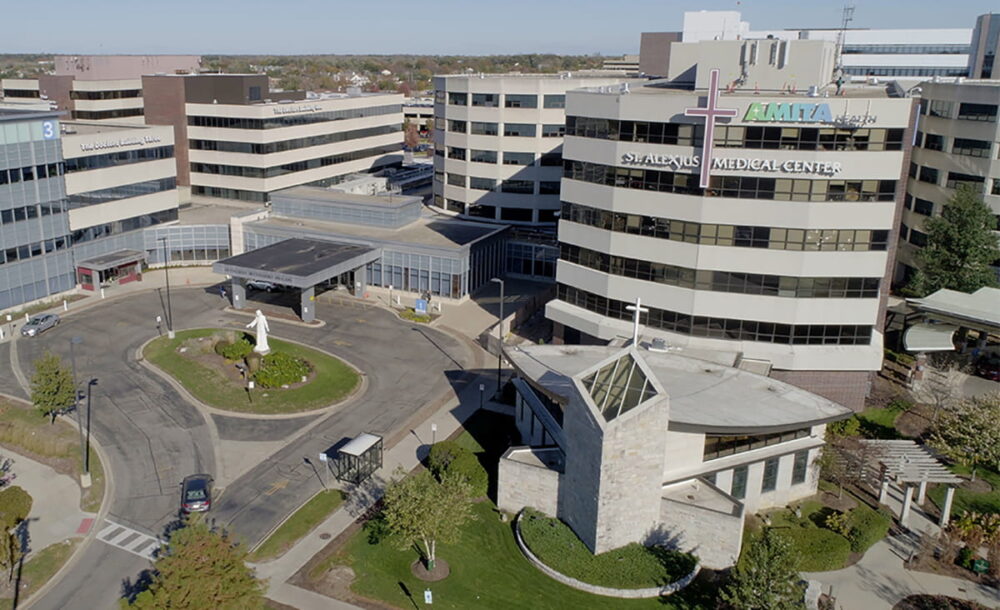
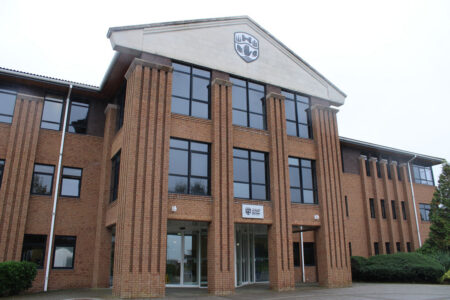
Easy. Simple to use. Push the button with confidence. These words echoed throughout the team at St. Alexius Medical Center when reviewing objectives for a new training center. Tasked with creating a whole new building near the Bismarck, ND campus that is home to the 306−bed hospital, the group required a presentation system that could be used daily for education. The users would range from professional presenters and trainers to senior citizens and serve the communities in around central and western North Dakota, South Dakota and eastern Montana.

Quote Icon
“The system was to be part of a multi−functional facility,
and our paramount challenge was simplicity.”
Jeff Beauchamp | Director of biomedical services, St. Alexius Medical Center

Local audio/video designer and installer Dakota Sound Systems worked with St. Alexius design technicians Justin Wilson and Rob Hoffman to assess the challenges of a new technology center. Together, the team created a design that features a training room that can be divided into four rooms, each seating up to 40 people. The rooms work together in pairs, with equipment shared between them. Each room has a projector with a projection screen and a custom podium where the presentation can be controlled with a Kramer RC−74DL master room controller. The panel has 12 programmable buttons that can be color−coded in groups of three, back−lit and labeled for easy source identification. The equipment rack includes a Kramer VP−725N Proscale® presentation digital scaler/switcher with 21 inputs that manages several sources including a Blu−Ray DVD player, digital tuner and VCR. The system also uses a Kramer (model #) 4×4 HDMI Matrix switcher and multiple sets of Kramer PT−571 and PT−572+ twisted pair transmitter/receivers. The system allows the option of sending the same content to both screens or presenting differing content on each screen.

“The presenter simply presses the ‘on’ button on the control panel and the system automatically lowers the projection screen, turns on the projector and switches to the desired source,” said Jay Griffin, vice president and co−owner of Dakota Sound Systems. “The Kramer product had the compatibility and the ease of use we needed for this project. In addition, the Kramer technology support group was always available by phone to work out any bumps,” he said. Likewise, Dakota Sound Systems extended that technology support to the team at St. Alexius, training and supporting them at any time.

Officials at St. Alexius note that they met their objectives with Kramer products in the system. “We wanted to be able to push one button and have the system work. We reached that goal,” Beauchamp said. “In addition, we are comfortable that we’ve set the stage for expansion by selecting Kramer products. We are poised for the future, yet still have a simple, easy−to−use system that meets our needs now,” he concluded.

Tags:

Education

Signal Management

Americas

United States

Got a question for one of our AV experts? Contact us here, and we’ll connect you.

Quote Icon
“The client was also very helpful in ensuring that the necessary infrastructures were available for us to complete the project on time.”
PAVE System

The Nanyang Technological University (NTU) in Singapore is an internationally reputed research-intensive tertiary institution. Their broad-based education covers science and technology, business and the arts, and entrepreneurial and leadership skills to prepare students for the global working world. Not surprisingly this fast-growing university with an international outlook also attracts many foreign students from across the world.

With this goal, the University management decided to create a comfortable and restful space for students and faculty from Singapore and around the globe to interact. A central location within the University grounds was allocated and, in August, the Global Lounge was born. The Lounge was designed for comfort and relaxation. At the entrance, a symbolic mural showcases the country flags of all the different students attending the university.

To ensure that the Lounge AV systems fulfilled their purpose, the University worked with Bosch, Kramer Asia Pacific and systems integrator PAVE System.

A major design requirement was to provide TV media content (VOD) to the students in the lounge according to their respective selections. A Bosch audio system allowed the students to personalize their audio selection on a custom−built stand. Also required was the lounge doubling up for presentation use. With this in mind, PAVE Systems designed a system to fulfil the client’s objectives.

The design was based on multiple input sources with different signal resolutions displayed on multiple displays with personalized listening. A Sierra Video 16×16 Matrix Switcher, multiple Kramer Scalers, eight Samsung 46” LCD panels and one 65” LCD panel created the multiple displays and a Bosch Multi−Channel Audio Selector personalized the listening.

A major design requirement was to provide TV media content (VOD) to the students in the lounge according to their respective selections.

The sleek customized stands for the personalized listening system had to be easily removed as needed to make space for other events. To this end, a mock-up of the customized stand was presented to the client and after some modifications, it was adopted.

The set−up also enabled the client to conduct regular presentations through two computer receptacle points at the front of the lounge. For presentations, the main audio system runs via an EV Digital Matrix Signal Processor and speaker system.

The PAVE team completed the project within 2 weeks. Jeffrey Lim of PAVE System said, “Kramer and Bosch facilitated the testing and mock-up during the conceptualisation of the design. Loan units were made available during customisation. The client was also very helpful in ensuring that the necessary infrastructures were available for us to complete the project on time”.

Tags:

Education

Control

APAC

Singapore

Got a question for one of our AV experts? Contact us here, and we’ll connect you.

Glasgow is the latest location for the development of McKenzie Group’s Academy venue roll-out. To supply and implement the audio infrastructure (as well as the video playback), MKG’s managing director, John Northcote, enlisted Shepperton Studios-based Marquee Audio. Marquee project managers, Spencer Brooks and Scott Wakelin, thus designed a reconfigurable system that would service all the venue’s requirements.

For the video, Marquee installed two 42″ plasma displays and a Sanyo projector in the Mezzanine room, Relaying show shots from the camera which occupies a fixed position at the stage. A further 42″ plasma screen is also situated high up in the VIP Room, with source selection, via a Kramer VS-5×4 matrix switcher, between the stage camera and DVD or video playback devices.

Thanks to Marquee Audio for help preparing this article and to Jerry Gilbert for permission to use his photographs.

Tags:

Education

Signal Management

EMEA

Got a question for one of our AV experts? Contact us here, and we’ll connect you.